A smart pumping station doesn’t need more complexity—it needs BL190 to collect data, control pumps locally, connect to SCADA via Modbus, and enable remote maintenance from anywhere.
Case Details
Sewage pumping stations are simple in concept—but surprisingly difficult to manage.
They are often distributed across residential communities, commercial buildings, industrial sites, and municipal networks. Most operate unattended, yet they still need to respond reliably to changing water levels, pump failures, communication interruptions, and alarm conditions.
The challenge is not simply controlling a pump.
The real challenge is keeping the station running locally while making its status visible remotely.
This is where an edge controller can make a difference.
The Problem with Traditional Pump Station Control
A typical small pumping station may use a combination of:
- PLC or relay-based control
- Remote I/O modules
- Modbus gateways
- Ethernet switches
- Level sensors
- VFDs or soft starters
- SCADA or cloud monitoring systems
Each component has a role, but the overall architecture can become unnecessarily complex for a small lift station.
Relay-based systems provide basic control but little visibility.
Traditional PLC architectures provide flexibility but may require additional I/O, communication gateways, and networking equipment.
And when something goes wrong, maintenance personnel may still need to travel to the site just to check a parameter, identify a fault, or change a control setting.
For distributed pumping stations, this creates unnecessary installation cost and maintenance effort.
A Different Approach: Local Control at the Edge
The BL190 Modbus EdgeIO Controller takes a different approach.
Instead of building the station around multiple independent components, BL190 consolidates I/O acquisition, local logic control, industrial communication, and networking into one compact platform.
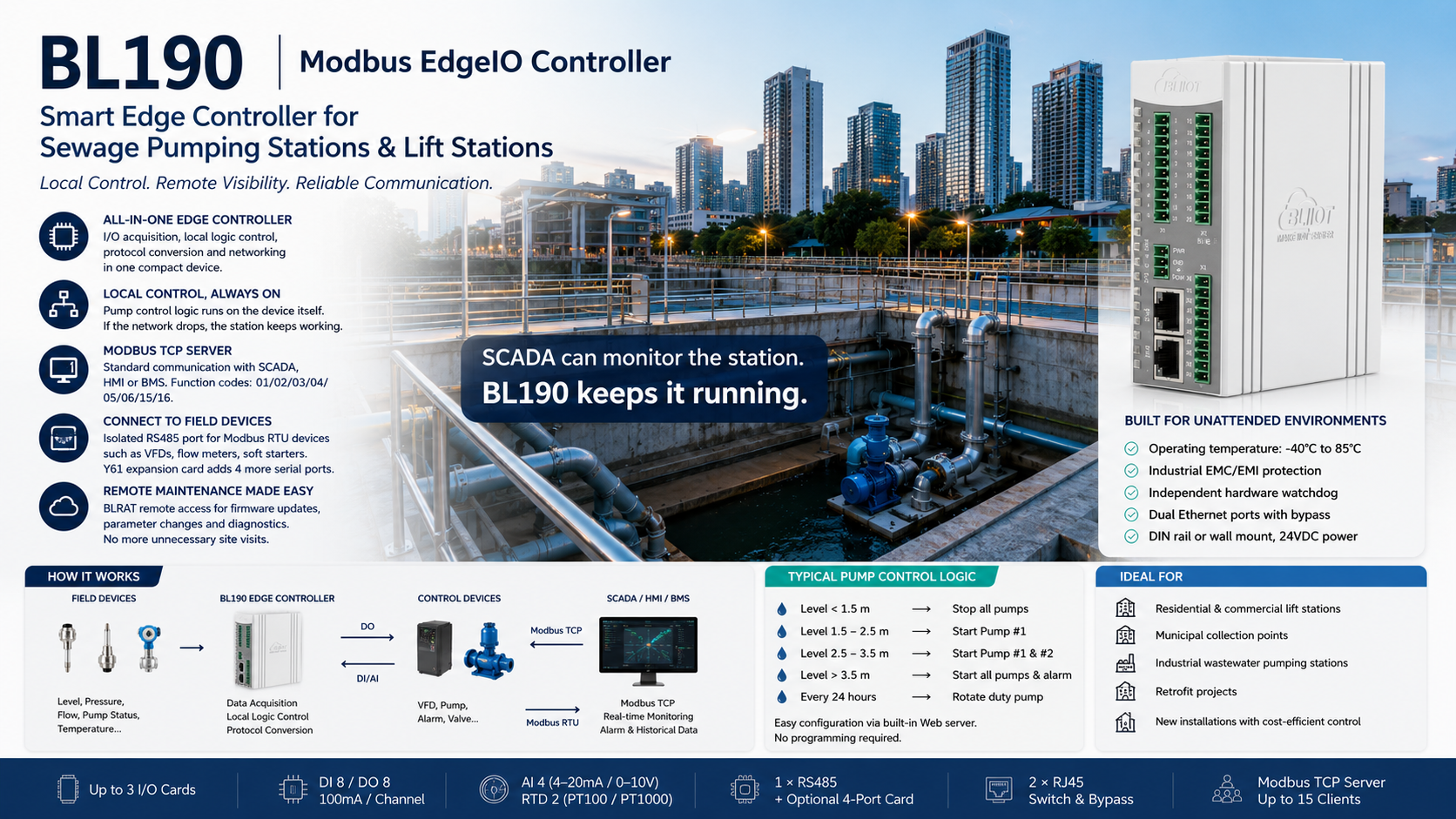
The principle is simple:
SCADA can monitor the pumping station. BL190 keeps it running.
The critical control logic stays at the station.
If communication with the central SCADA system is interrupted, the local controller can continue executing the configured pump control logic.
That means the station does not have to depend on a remote server for basic operation.
What BL190 Does at a Sewage Pumping Station
1. Collects Field Data
A pumping station may need to monitor:
- Liquid level
- Discharge pressure
- Pump running status
- Pump fault status
- Hand/Auto mode
- Motor temperature
- Flow rate
- VFD operating parameters
BL190's modular I/O architecture allows the controller to be configured according to the actual requirements of the station.
Analog signals such as 4–20 mA level sensors can be collected directly, while digital inputs can monitor pump status and alarms.
Different I/O combinations can be selected for different station configurations, including DI, DO, AI, AO, RTD, TC, and pulse-counting applications.
2. Controls Pumps Locally
The controller can execute pump control logic directly at the edge.
For example:
- Level below 1.5 m → Stop all pumps
- Level between 1.5–2.5 m → Start Pump #1
- Level between 2.5–3.5 m → Start Pumps #1 and #2
- Level above 3.5 m → Start all pumps and trigger a high-level alarm
- Every 24 hours → Rotate the duty pump
This type of condition-action logic can be configured through the web interface without building a complex PLC program.
The configuration is stored in non-volatile memory, so the control rules remain available after a power cycle.
More importantly, the control logic runs locally.
The network can fail. The pump station can still operate.
3. Connects to SCADA, HMI and BMS
Once field data has been collected, the next question is:
How does the pumping station communicate with the upper-level system?
BL190 provides a standard Modbus TCP Server on port 502.
It can connect to:
- SCADA systems
- HMIs
- Building Management Systems
- Industrial monitoring platforms
- Edge computing platforms
Standard Modbus function codes are supported, including:
01 / 02 / 03 / 04 / 05 / 06 / 15 / 16
For systems using Modbus TCP, there is no need to introduce a proprietary communication layer.
The controller simply exposes the station's data through a familiar industrial protocol.
4. Communicates with Existing Field Devices
Pumping stations rarely contain only pumps.
They may also include:
- VFDs
- Soft starters
- Flow meters
- Pressure transmitters
- Energy meters
- Other Modbus RTU instruments
BL190 provides an isolated RS485 interface for Modbus RTU communication.
When additional serial communication is required, the optional Y61 expansion card provides four additional serial ports.
This allows system integrators to connect multiple field devices without adding separate protocol gateways for every device.
5. Remote Maintenance Without Driving to the Site
One of the biggest costs in distributed pumping station management is not the hardware.
It is the site visit.
A technician may need to travel to a remote station simply to:
- Change a level setpoint
- Check controller parameters
- Update firmware
- Investigate a communication problem
- Diagnose an unexpected pump condition
With BL190 and its BLRAT remote access capability, authorized personnel can perform remote maintenance and configuration tasks without necessarily visiting the station.
For operators managing dozens or hundreds of distributed lift stations, this can significantly simplify maintenance.
Built for Unattended Industrial Sites
A remote pumping station is not a laboratory environment.
Equipment may be installed in outdoor cabinets, underground facilities, utility rooms, or locations with limited environmental control.
BL190 is designed for industrial operating conditions:
- Operating temperature: -40°C to 85°C
- Industrial EMC/EMI design
- Independent hardware watchdog
- Dual Ethernet ports
- Ethernet bypass capability
- Isolated RS485 communication
- DIN rail or wall mounting
- 24 VDC power supply
The dual Ethernet design with bypass can also help maintain network connectivity in daisy-chained installations.
If one controller encounters a failure, network traffic can continue to pass through the bypass path, helping prevent one failed node from unnecessarily isolating downstream stations.
A Practical Architecture for a Small Lift Station
A typical installation could look like this:
Level Sensor → BL190 AI → Local Pump Logic → BL190 DO → Pump/VFD
At the same time:
VFD / Flow Meter → RS485 Modbus RTU → BL190
And:
BL190 → Ethernet / Modbus TCP → SCADA / HMI / BMS
This creates a simple architecture with four key functions in one controller:
Sense → Decide → Control → Communicate
The station can operate locally while still becoming part of a larger monitoring and management system.
Traditional Architecture vs. BL190 Approach
The goal is not to replace every PLC in every pumping station.
For large wastewater treatment plants, redundant control systems, and complex DCS applications, a full PLC or DCS architecture may still be the right choice.
BL190 is better suited to distributed, relatively small, unattended pumping stations where a traditional automation architecture may be unnecessarily complex or expensive.
Where BL190 Fits Best
BL190 can be considered for applications such as:
- Residential sewage lift stations
- Commercial building sump systems
- Small municipal pumping stations
- Distributed wastewater collection points
- Industrial wastewater pumping stations
- Remote drainage stations
- Retrofit projects replacing relay-based controls
- New installations requiring local control and remote monitoring
For system integrators, the modular architecture also makes it easier to create a standardized control platform that can be adapted to different pump counts, sensor configurations, and communication requirements.
The Bottom Line
A sewage pumping station does not necessarily need a complicated automation architecture.
It needs four things:
Reliable local control. Clear operational visibility. Standard industrial communication. Remote maintenance capability.
That is where an edge controller fits.
The BL190 Modbus EdgeIO Controller brings I/O acquisition, local control, Modbus communication, networking, and remote maintenance into one compact industrial platform.
For distributed lift stations, the value is not simply having another controller.
It is having a controller that can keep the station running locally, connect it to the systems you already use, and reduce the number of times someone has to drive there.
Simple to specify. Simple to integrate. Built for the edge.
For more details, https://bliiot.com/collections/industrial-edgeio-controllers


